Monday, 23 September 2013

Mallard at Grantham

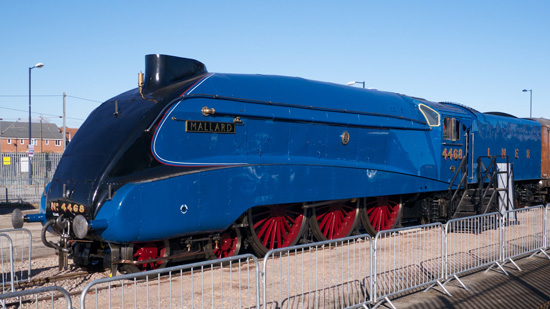
LNER A4 class 4-6-2 4468 MALLARD-20130907LNER A4 class 4-6-2, 4468 MALLARD, 7/9/13

You may have noticed by now that I tend to photograph and write about the less 'mainstream' aspects of railways… It's not that I'm not interested in the mainstream, I'm just more interested in the weird and wonderful, the obscure and the forgotten…

That said, I couldn't pass up the chance of seeing the legendary London & North Eastern Railway A4 class 4-6-2 steam loco 4468 MALLARD when it was recently on display at Grantham as the centrepiece of the 'MALLARD the story of speed' exhibition commemorating the 75th anniversary of the world speed record of 125.88mph that MALLARD achieved on July 3 1938 on the slight downward grade of Stoke Bank just south of Grantham.

I arrived when the event was still over an hour away from opening to the public but there was no shortage of people lining up to poke their cameras through the fence to get photos in superb weather conditions!

The National Railway Museum have to be congratulated for allowing such an important exhibit as this to be displayed in this manner and I can only hope more such instances will follow… Anyone for the Midland Railway "Spinner" 4-2-2 No.118 at Derby station?

Sunday, 1 September 2013

Signalbox Safari - Postland

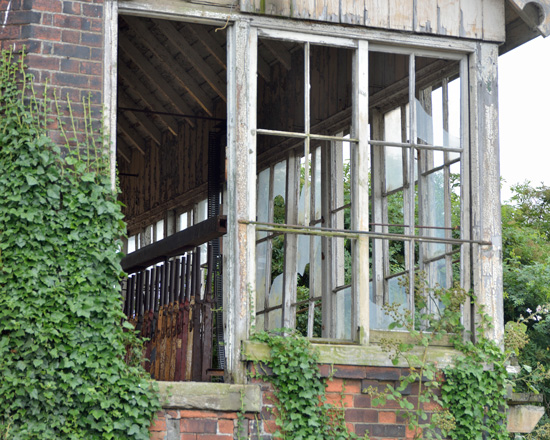
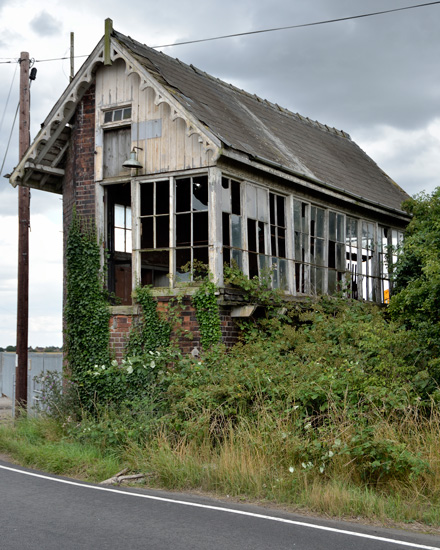
Postland signalbox-20130803Postland signalbox (Lincolnshire), 3/8/13

I was tipped off to this particular signalbox by a tweet on the Railways Illustrated twitter feed a few weeks ago and decided to pay a visit.

Postland was a station on the Great Northern and Great Eastern Joint Railway line between Spalding in Lincolnshire and Whitemoor Jn. north of March in Cambridgeshire that opened in 1867. Named Crowland until 1871, Postland station closed in September 1961 but the line remained open until 27 November 1982 after which all traffic was diverted via Peterborough. I'm not sure when local services between Spalding and March ceased but the line was in use by long-distance trains linking East Anglia and the north right up until the end.

The Signalbox itself is a Great Northern Railway 'type 1' dating from 1882 and amazingly still contains it's original 35-lever frame. I can only assume that the cut-off rear corner of the box is to provide extra clearance for the road which curves sharply at this point.

Postland signalbox lever frame-20130803Postland signalbox lever frame, 3/8/13

I should point out here (before somebody else does) that strictly the section of line between Whitemoor Jn. and Spalding wasn't 'Joint' at all, being opened solely by the Great Northern Railway but is regarded as being part of the GN&GE.

Other boxes on the line also survive, notably at Cowbit and French Drove & Gedney Hill but have been (or are being) converted into private homes and as such enthusiasts may not be able (or welcome) to view them.

Monday, 26 August 2013

Coincidences…

When I first encountered the 0-4-0VBT locomotives built by De Winton of Carnarvon I was immediately struck by how 'cobbled together' they looked, seeming to be part locomotive, part coffee-pot!
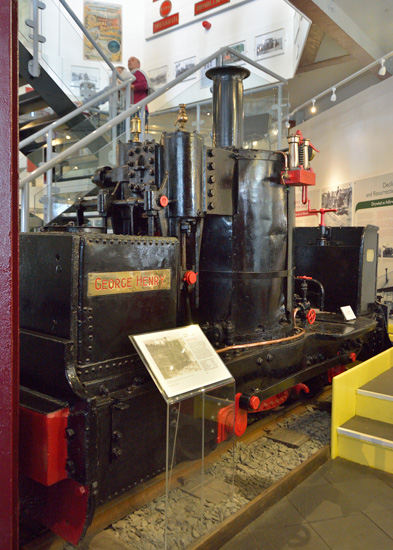
Now this turns out to be a bit of a coincidence strewn entry because the family of a close friend of mine always refer to anything that looks cobbled together as being 'George Henry'd' after an ancestor who was quite adept at what I would call 'the art of bodging' so during my recent visit to the Narrow Gauge Railway Museum I just had to take a photograph of a De Winton locomotive named 'GEORGE HENRY' that was used in the Slate Quarries at Penrhyn.

De Winton 0-4-0VBT George Henry-20130816De Winton 0-4-0VBT GEORGE HENRY, NGRM, 16/8/13

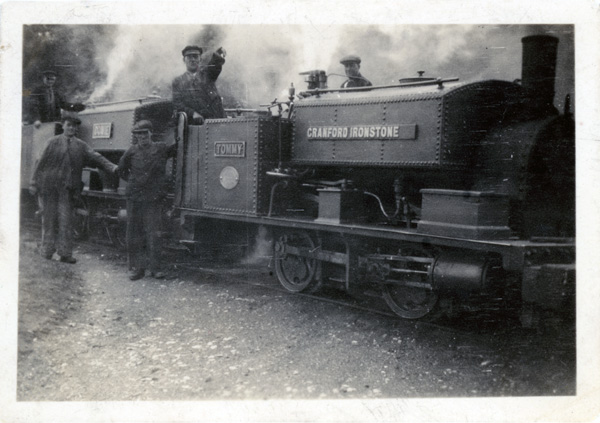
I showed the photo to my friend and after much rummaging in cupboards she produced the photo below, coincidentally showing the subjects of my last post DOWIE and TOMMY with none other than (her grandfather) George Henry himself on the footplate!

Dowie, Tommy and George Henry HensonDOWIE, TOMMY and George Henry Henson, date unknown
Photo courtesy of the Henson family archive.

It turns out that George Henry Henson was one of a number of family members that worked either in the quarry at Crich or on George Stephenson's mineral railway and along with his brother, Harold, was consulted during the writing of the book 'The Crich Mineral Railways' published in 1971 that first sparked my interest in the line.

What a small world we live in…

Monday, 19 August 2013

Derbyshire railway history… In Wales!

This week I finally got to pay my first visit to the Talyllyn Railway, and amazingly (given my  track record where visits to Wales are concerned) in glorious weather!

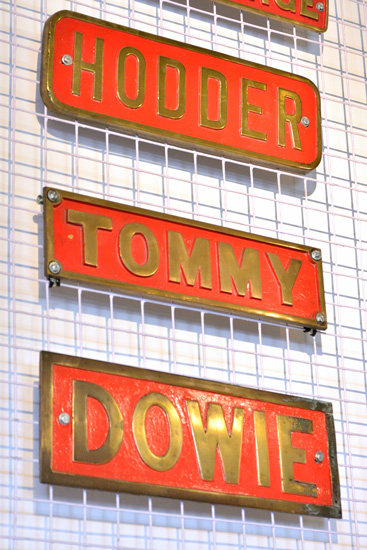
Whilst waiting for No.1 'TALYLLYN' to arrive with our train Joy and I had a wander around the Narrow Gauge Railway Museum at Tywyn Wharf and came across these…

HODDER, TOMMY and DOWIE nameplates-20130816HODDER, TOMMY & DOWIE nameplates, NGRM, 16/8/13

HODDER, TOMMY and DOWIE, nameplates from three steam locomotives that once worked a line very close to where I grew up (albeit well before my time!)

The line in question was (unusually for the UK) a metre gauge concern that carried limestone from Cliff Quarry in Crich, Derbyshire (now home to the Crich Tramway Village) down to lime kilns by the side of the North Midland Railway line at Ambergate, constructed by none other than George Stephenson, renowned as the 'Father of Railways' and was opened in 1841 using a mixture of self-acting inclines and horses to move the wagons.

DOWIE was the first steam locomotive to arrive in 1893 being constructed by Markham and Co. Ltd. of Chesterfield at a cost of £500. A De Winton & Co. 'coffee-pot' purchased from an unknown source in 1899 became the first of two locomotives to be named TOMMY but wasn't a huge success, eventually being replaced by a secondhand locomotive identical to DOWIE built in 1889 by Oliver & Co. Ltd. of Chesterfield (who later changed their name to Markham and Co.)

HODDER (a Peckett dating from 1924) was the fourth and final steam locomotive bought for the line in 1934 from William Twigg, an engineering dealer at Matlock. A much larger locomotive than DOWIE and TOMMY, HODDER had to be cut-down in size but even with a severely truncated chimney it still only cleared the village tunnel roof by a couple of inches.

Cliff Quarry (although reopened at a later date in a limited capacity) and the railway closed in May 1957 without ceremony and as far as I am aware none of the steam locomotives survive.

Tuesday, 30 July 2013

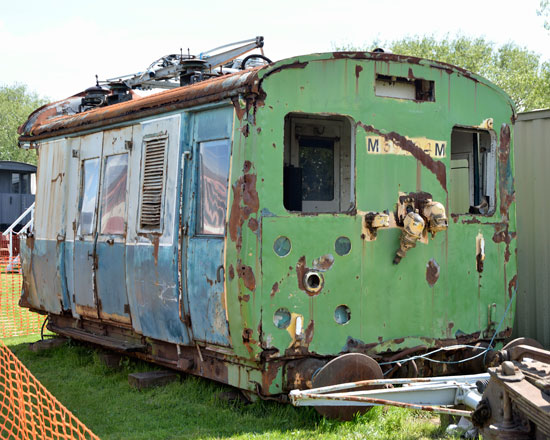
Class 506 remains at the Electric Railway Museum

Class 506 cab-20130525Class 506 cab at the Electric Railway Museum, 25/5/13

This rather sorry looking specimen is all that remains of the eight 3-car Class 506 1,500V DC EMUs built for local services between Manchester, Glossop and Hadfield on the legendary 'Woodhead Line' linking Manchester and Sheffield.

Ordered in 1938, built in 1950 and finally entering service in 1954 these units were withdrawn in 1984 following both closure of the Woodhead line east of Hadfield and conversion of the remaining section to the 25kV AC overhead system. One unit was saved for preservation but deteriorated severely in open storage (at Dinting Railway Museum and the Midland Railway-Butterley amongst other places) and was sent for scrap in 1995.

This driving end of DMBSO M59404M (b.1950, Metro-Cammell) recently moved from Barrow Hill Roundhouse to the Electric Railway Museum near Coventry is all that survives.

Tuesday, 16 July 2013

Signalbox Safari - Dersingham

I have a liking for Signalboxes… I don't think there can be any other building that shouts 'RAILWAY!' quite as loudly as a signalbox and I try to photograph them wherever they crop up.

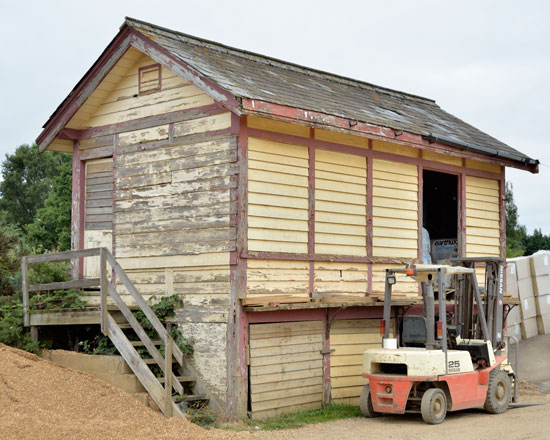
Dersingham signalbox-20130711Dersingham signalbox (Norfolk), 11/7/13

Dersingham was a station on the Lynn & Hunstanton Railway, half way between (funnily enough) King's Lynn and Hunstanton that opened in 1862 and although the line closed in 1969 most of the buildings have survived (relatively) intact.

The line became part of the Great Eastern Railway in 1890 and the signalbox, dating from 1891, is a GER 'type 7' now in use as a store for a builder's merchant (who kindly allowed me onto the site to take photographs).

I particularly like the way the building has been modified to suit its new role with removable panels at ground level allowing access to the former locking room.

Thursday, 27 June 2013

Secret Simplex at the EARM

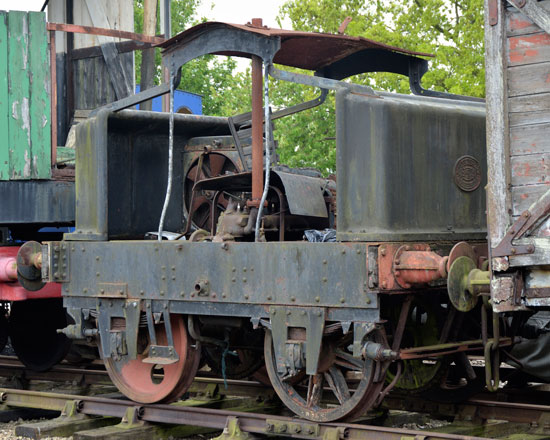
MR 4wPM (works no.2029 of 1920)-20130520Simplex 4wPM 2029 of 1920 at the East Anglian Railway Museum, 20/5/13

A recent(ish) visit to the East Anglian Railway Museum on a very dull Monday afternoon was an enjoyable, if quiet (I seemed to have the whole place to myself apart from two staff members) experience. I spent a couple of hours wandering round, photographing anything that caught my eye and dodging the rain showers.

I found this little gem interesting, a Simplex 4-wheel petrol mechanical locomotive that is far smaller than the wagons it was designed to pull. Built at the Motor Rail & Tramcar Co Ltd in Bedford in 1920 as works no.2029 it is believed to have spent its working life at various locations in Cambridgeshire and Northamptonshire, more than that I don't know, unfortunately the EARM website tells me more about 'Milo Mouse' ('a friendly character who will guide children around the museum while completing a range of fun activities') than the items on display there and the souvenir guide doesn't mention it either!

I doubt that the odd arrangement of wheels, 3-hole disc on one axle, split spoke on the other is original and I don't know for certain but I wouldn't be at all surprised to find that the small hole on the middle of the side frame is for a starting handle!